Car Seat Installation Guide UAE – Step-by-Step Installation, Safety Rules & Tips
Installing a child car seat correctly is one of the most important things parents can do before driving with a baby or young child. Simply placing a car seat on the back seat is not enough. The seat must be suitable for the child’s size, correctly secured to the vehicle and properly adjusted around the child.
In the UAE, child car seats are also an important part of road-safety requirements. Dubai’s Roads and Transport Authority (RTA) advises parents to select a seat appropriate for the child’s age and weight, follow the manufacturer’s installation instructions and check that the seat is compatible with the vehicle’s anchoring system or seat belt.
Official UAE Safety Resources: Before installing a child car seat, parents can review the latest guidance from Dubai Roads and Transport Authority (RTA) and the UAE Government children’s safety portal. RTA’s driving-safety handbook also explains child-seat requirements and age/size considerations. Always follow the instructions supplied with your specific car seat and vehicle because installation methods can differ between models.
What Is a Car Seat Installation Guide?
A car seat installation guide explains how to correctly secure a child safety seat inside a vehicle and how to position the child within that seat.
There are several common installation methods:
- ISOFIX installation
- Vehicle seat-belt installation
- Rear-facing installation
- Forward-facing installation
- Booster-seat installation
The correct method depends on the child’s age, height, weight, the type of car seat and the vehicle.
A seat that looks secure is not necessarily installed correctly. It should not move excessively at the installation point, the harness should be correctly adjusted and the seat should be installed exactly according to the manufacturer’s instructions.
Why Correct Car Seat Installation Matters
A child safety seat is designed to distribute crash forces and keep a child properly restrained.
An incorrectly installed seat can reduce its effectiveness even if the seat itself has passed safety testing.
Common installation problems include:
- Loose installation
- Incorrect seat angle
- Incorrect harness height
- Twisted harness straps
- Loose harness
- Incorrect use of the vehicle seat belt
- Incorrect ISOFIX attachment
- Using an incompatible vehicle seating position
- Placing a rear-facing seat in front of an active airbag
- Moving a child to a booster seat too early
RTA specifically advises parents to test the installation before purchasing the seat to make sure it is compatible with the vehicle’s anchoring system or seat belt.
UAE Child Car Seat Rules
Parents should understand the UAE requirements before travelling with children.
According to the UAE traffic regulations published by the government, children under four years old must be secured in an appropriate child seat. The published violation schedule lists a AED 400 fine for failing to secure child seats for children under four. It also lists a AED 400 fine for allowing children under 10 years old or shorter than 145 cm to sit in the front seat.
RTA and Dubai Police have also highlighted that children should be placed in suitable rear-seat restraints rather than being held by an adult while the vehicle is moving.
UAE Child Safety Quick Facts
| Safety Rule | Important Information |
|---|---|
| Child under 4 | Appropriate child safety seat required |
| Child under 10 | Should not sit in the front seat |
| Child shorter than 145 cm | Should not sit in the front seat |
| Rear seat | Recommended location for child restraint |
| Installation | Follow the car-seat and vehicle manufacturer’s instructions |
| Airbag | Never place a rear-facing seat in front of an active passenger airbag |
| Fine for missing child seat under 4 | AED 400 |
| Fine for child under 10 or below 145 cm in front | AED 400 |
Rules and enforcement information can change, so check the latest official UAE and RTA information before relying on an older guide.
Types of Child Car Seats
Choosing the correct seat is just as important as installing it correctly.
Infant Car Seat
Infant seats are generally designed for babies and are installed rear-facing.
Rear-facing positioning supports the baby’s head, neck and spine by distributing crash forces across the back of the seat.
Convertible Car Seat
A convertible seat can generally be used in more than one configuration.
Depending on the manufacturer’s specifications, it may be used:
- Rear-facing for younger children
- Forward-facing when the child reaches the appropriate stage
Always use the seat according to its specific height and weight limits.
Forward-Facing Car Seat
Forward-facing seats are designed for children who have reached the appropriate stage according to the manufacturer’s instructions.
These seats generally use an integrated harness to secure the child.
Booster Seat
A booster seat raises the child so the vehicle’s seat belt can fit correctly across the stronger parts of the body.
The decision to move from a harnessed seat to a booster should be based on the child’s size and the manufacturer’s requirements rather than age alone.
ISOFIX vs Seat Belt Installation
Parents often ask whether ISOFIX or a seat belt is safer.
The answer depends on the specific child seat and vehicle.
ISOFIX Installation
ISOFIX uses dedicated attachment points built into compatible vehicles.
Advantages include:
- Easy attachment
- Reduced installation mistakes
- Direct connection to vehicle anchor points
- Clear installation indicators on many seats
However, not every ISOFIX seat is compatible with every vehicle seating position.
Seat Belt Installation
Some child seats are designed to be installed using the vehicle’s seat belt.
This can work safely when the belt is routed exactly through the correct paths and tightened according to the manufacturer’s instructions.
A seat-belt installation should never be improvised.
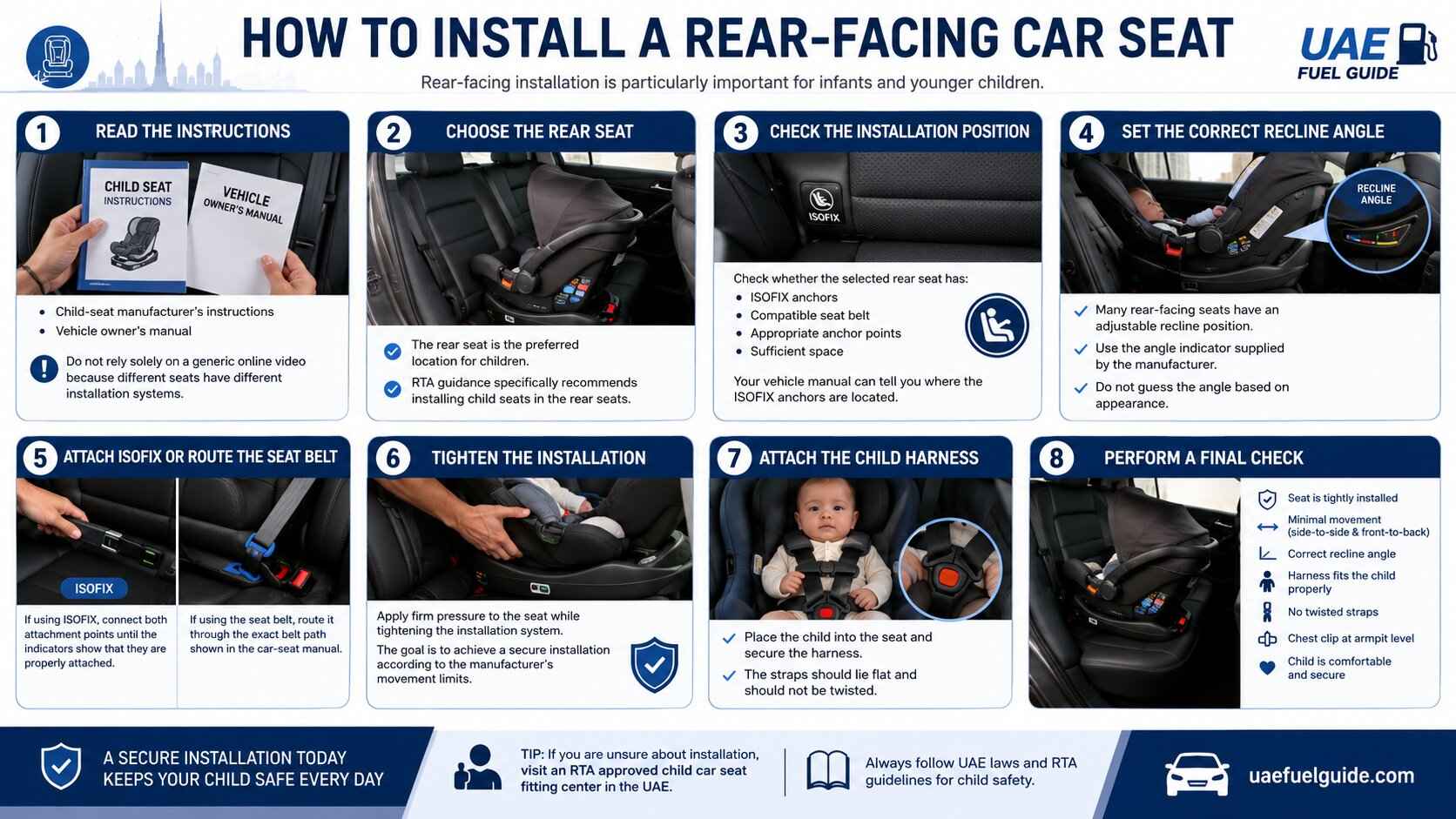
How to Install a Rear-Facing Car Seat
Rear-facing installation is particularly important for infants and younger children.
Step 1: Read the Instructions
Before putting the seat in the car, read both:
- Child-seat manufacturer’s instructions
- Vehicle owner’s manual
Do not rely solely on a generic online video because different seats have different installation systems.
Step 2: Choose the Rear Seat
The rear seat is the preferred location for children.
RTA guidance specifically recommends installing child seats in the rear seats.
Step 3: Check the Installation Position
Check whether the selected rear seat has:
- ISOFIX anchors
- Compatible seat belt
- Appropriate anchor points
- Sufficient space
Your vehicle manual can tell you where the ISOFIX anchors are located.
Step 4: Set the Correct Recline Angle
Many rear-facing seats have an adjustable recline position.
Use the angle indicator supplied by the manufacturer.
Do not guess the angle based on appearance.
Step 5: Attach ISOFIX or Route the Seat Belt
If using ISOFIX, connect both attachment points until the indicators show that they are properly attached.
If using the seat belt, route it through the exact belt path shown in the car-seat manual.
Step 6: Tighten the Installation
Apply firm pressure to the seat while tightening the installation system.
The goal is to achieve a secure installation according to the manufacturer’s movement limits.
Step 7: Attach the Child Harness
Place the child into the seat and secure the harness.
The straps should lie flat and should not be twisted.
Step 8: Perform a Final Check
Before driving, check:
- Seat attachment
- Recline indicator
- Harness
- Buckle
- Chest clip if included
- Vehicle seat belt
- ISOFIX indicators
How to Install a Forward-Facing Car Seat
Forward-facing installation should only be used when the child meets the seat manufacturer’s requirements.
Step 1: Confirm the Child Is Ready
Check the manufacturer’s minimum and maximum:
- Weight
- Height
- Age guidance
Do not move a child forward-facing simply because they appear uncomfortable in a rear-facing position.
Step 2: Position the Seat in the Rear
Choose an appropriate rear seating position.
Step 3: Connect ISOFIX or Seat Belt
Follow the specific installation method supplied with the seat.
Step 4: Use the Top Tether if Required
Some forward-facing seats require a top tether.
If your seat and vehicle are designed for a top tether, connect it to the correct anchor point identified in the vehicle manual.
Never attach the tether to an arbitrary hook or luggage point.
Step 5: Tighten the Seat
Remove unnecessary slack from the installation system.
Step 6: Adjust the Harness
The harness should sit correctly around the child’s body according to the seat manufacturer’s instructions.
Step 7: Check Before Driving
Perform the same final safety inspection every time.
How to Install a Booster Seat
A booster seat works differently from a harnessed child seat.
Its purpose is to position the child correctly so the vehicle’s three-point seat belt fits properly.
The lap portion should sit low across the child’s upper thighs rather than across the stomach.
The shoulder portion should cross the chest and shoulder area correctly.
Never place the shoulder belt behind the child’s back or under the arm.
How to Check If Your Car Seat Is Tight Enough
One of the most common questions in car seat installation is how much movement is acceptable.
Follow your seat manufacturer’s instructions because testing methods can differ.
In general, check the seat at the designated installation point rather than pulling aggressively from the top of the seat.
If the installation appears loose, remove it and reinstall it rather than simply adding padding or modifying the attachment system.
Car Seat Harness Adjustment Guide
Correct harness adjustment is just as important as securing the seat itself.
Keep Harness Straps Flat
Twisted straps can change how the harness performs.
Remove Thick Jackets
RTA advises removing thick clothing so the harness can fit securely against the child’s body.
Instead of placing a child in a bulky winter jacket, secure the harness first and then use a blanket over the child if needed.
Check the Harness
The harness should be snug according to the seat manufacturer’s instructions.
Do not leave excessive slack around the shoulders and chest.
Where Should a Baby Car Seat Be Installed?
The rear seat is generally the safest location for a child restraint.
If your vehicle has multiple rear seating positions, check the vehicle manual and child-seat instructions to determine which position is approved for the particular installation method.
Some seats may allow installation in specific positions only.
Do not assume that every seating position has ISOFIX anchors.
Can You Put a Baby Car Seat in the Front Seat?
For safety and UAE legal requirements, children should be properly restrained in the rear.
A rear-facing child seat must never be placed in front of an active passenger airbag.
RTA’s safety handbook warns that a front passenger airbag can cause fatal injuries to an infant in a rear-facing seat.
The UAE traffic rules also prohibit children under 10 years old or shorter than 145 cm from sitting in the front seat.
Common Car Seat Installation Mistakes
Installing the Seat Too Loosely
A loose seat can move excessively during a collision.
Using the Wrong Belt Path
A seat belt must pass through the exact routing points specified by the manufacturer.
Forgetting the Top Tether
If your forward-facing installation requires a top tether, make sure it is attached correctly.
Twisting the Harness
Harness straps should lie flat.
Leaving Thick Clothing Under the Harness
Bulky clothing can interfere with proper harness tightening.
Using Extra Padding
Do not add aftermarket cushions, inserts or accessories unless they are approved for use with your specific car seat.
Using an Expired or Damaged Seat
Check the manufacturer’s expiration and condition requirements.
Continuing to Use a Seat After a Crash
RTA advises replacing a child seat after a collision because its internal structure may have been compromised.
Car Seat Installation Checklist
Before driving, use this quick checklist.
| Check | Status |
|---|---|
| Correct child seat for size | ✓ |
| Rear-seat position selected | ✓ |
| ISOFIX or seat belt correctly attached | ✓ |
| Correct installation angle | ✓ |
| Seat installation tightened | ✓ |
| Harness flat and untwisted | ✓ |
| Harness adjusted correctly | ✓ |
| Buckle properly fastened | ✓ |
| Top tether attached if required | ✓ |
| No thick clothing under harness | ✓ |
| No unauthorized accessories | ✓ |
| Vehicle and car-seat manuals checked | ✓ |
Car Seat Installation for Newborns
Newborns require particular attention because their head, neck and body are still developing.
A newborn should use an appropriate infant restraint designed for their size.
The seat should normally be rear-facing, with the correct recline angle and harness adjustment.
RTA’s current child-safety guidance specifically emphasizes choosing a seat according to the child’s age and weight and following the manufacturer’s instructions.
Parents should never hold a newborn in their arms while the vehicle is moving.
Car Seat Installation in SUVs
SUVs are increasingly common in the UAE, but their larger size does not automatically make every seating position suitable for every car seat.
Before installing a seat in an SUV, check:
- ISOFIX availability
- Top-tether anchor location
- Seat-belt routing
- Seat angle
- Third-row compatibility
- Airbag configuration
- Vehicle manufacturer’s instructions
If using the third row, confirm that your specific child seat is approved for that seating position.
Car Seat Installation in Sedans
Most modern sedans have rear seat belts and, depending on the model, ISOFIX attachment points.
Before installation, check the vehicle manual for the exact anchor locations.
Pay attention to the angle of the rear seat cushion because it can affect how the child seat sits.
Car Seat Installation in Taxis and Rental Cars
Families travelling around Dubai may use taxis or rental cars.
Do not assume that a child can simply be held by an adult because the journey is short.
Parents travelling with young children should plan appropriate child restraint arrangements in advance and confirm availability when booking a rental vehicle or transportation service.
How Often Should You Check a Child Car Seat?
Car seats should be checked regularly.
RTA advises parents to inspect:
- Harness
- Buckles
- Fastenings
- General seat condition
The inspection is especially important after an accident or if the seat has been removed and reinstalled several times.
A quick check before every journey is also a good habit.
When Should You Replace a Car Seat?
Replace the seat when:
- It has been involved in a collision
- It is damaged
- The manufacturer says it has expired
- The harness or buckle is damaged
- Required parts are missing
- You cannot verify its history
- It no longer fits the child’s size requirements
Do not buy a second-hand car seat if you cannot confirm its history and condition.
How Long Can a Child Stay in a Car Seat?
RTA’s current guidance advises avoiding keeping a child in the seat for more than 30 consecutive minutes.
This is particularly relevant for infants.
For longer journeys, parents should plan suitable breaks rather than treating the car seat as a general-purpose sleeping or feeding seat outside the vehicle.
Can a Baby Sleep in a Car Seat?
A car seat is designed for travel and should be used according to the manufacturer’s instructions.
RTA advises against using the car seat for purposes such as feeding the child or allowing the child to sleep at home.
Once you arrive at your destination, follow safe-sleep guidance and the manufacturer’s instructions rather than using the car seat as a routine sleeping location.
Car Seat Installation Guide for UAE Summer
The UAE’s extreme summer temperatures create an additional consideration for families.
Never leave a child unattended in a parked vehicle.
Before placing the child into the seat:
- Check the seat temperature.
- Keep the vehicle properly ventilated and cooled.
- Avoid exposing buckles and metal components to excessive heat.
- Check that the harness is comfortable.
- Never leave the child alone inside a parked vehicle.
A car can become dangerously hot very quickly, even when the vehicle is parked for a short time.
What to Bring When Buying a Car Seat
Before purchasing a child car seat, take your vehicle information with you.
Useful information includes:
- Vehicle make
- Model
- Model year
- Number of children
- Child’s age
- Child’s height
- Child’s weight
- Vehicle owner’s manual
If possible, test the seat in your actual vehicle before purchasing.
RTA specifically recommends testing the installation before purchase to confirm compatibility with the vehicle’s anchoring system or seat belt.
How to Make Car Seat Installation Easier
A few simple habits can make installation much easier.
Keep the Manual in the Car
Store the car-seat manual somewhere accessible.
Take a Photograph
After completing a correct installation, you can take a reference photograph showing the correct routing and positioning.
Learn Your ISOFIX Points
Locate your vehicle’s ISOFIX anchors before purchasing an ISOFIX seat.
Check the Seat Regularly
A car seat can become loose after repeated use or adjustment.
Don’t Rush
Take the time to install the seat correctly before starting your journey.
Car Seat Installation Checklist for Parents
Before every trip, ask:
Is the child in the correct seat?
Is the seat installed according to the manufacturer’s instructions?
Is the harness correctly tightened?
Are the straps flat and untwisted?
Is the seat positioned in the rear?
Is the child wearing suitable clothing?
Are ISOFIX or seat-belt attachments secure?
Is the top tether attached if required?
Has the seat ever been involved in a collision?
Is the seat still within the manufacturer’s usable period?
If the answer to any safety question is unclear, stop and check the manufacturer’s instructions before driving.
Final Thoughts
A proper car seat installation guide should be more than a simple list of steps. The correct child restraint, correct seating position, correct installation method and correct harness adjustment all work together to protect a child.
For families in the UAE, understanding the local requirements is equally important. Children under four must be secured in an appropriate child seat, while children under 10 years old or shorter than 145 cm are not permitted to sit in the front seat under the published UAE traffic rules. The listed penalty for these violations is AED 400.
The safest approach is to select a seat based on the child’s size, verify that it is compatible with your vehicle, install it exactly according to the manufacturer’s instructions and check it regularly.
For more UAE automotive, driving and road-safety guides, visit the UAEFuelGuide.com homepage.