
At-Home Lab Testing: Everything You Need to Know Before You Book

Booking a lab test at home is simple on the surface. Someone visits your house, draws a sample, and results arrive on your phone a day or two later. But most people book their first appointment without knowing what is actually being tested, how to prepare, or what separates a reliable provider from one cutting corners. Here is what to know before you book a medical test at home.
Why People Choose Home Testing
The main draw is obvious. A home service blood test removes the commute, the waiting room, and the need to take time off work for something that used to eat up half a day. But convenience is only part of it. For elderly patients, people with limited mobility, or anyone anxious about clinical settings, testing from home also removes a real barrier to getting checked regularly in the first place.
How the Process Actually Works
Booking is usually done online or by phone, with a time slot chosen based on your schedule rather than a clinic’s opening hours. A certified phlebotomist arrives with the same equipment used in a hospital lab, draws the sample, and transports it under proper cold chain conditions to an accredited lab for processing. Results are typically ready within 24 to 48 hours and delivered digitally, so there is no need to call in or pick up a printed report.
Understanding a Standard Blood Panel
Most people booking a blood test at home are unaware of what the individual markers on their report actually mean. A complete blood count typically includes the MCH blood test and MCHC blood test values, which show how much hemoglobin is present in red blood cells and how concentrated it is. The MCV blood test measures the size of those cells, and together these three numbers help identify different types of anemia. An SGPT test checks liver enzyme activity, and SGPT test means the ALT enzyme rises when the liver is under stress, often before other symptoms appear. A ferritin test is usually included as well, and ferritin meaning in this context refers to your body’s stored iron rather than what is circulating in your blood at that moment. A CRP blood test meaning elevated levels flags inflammation somewhere in the body, though it does not indicate the exact cause on its own. Many providers also offer a HOMA IR test, which estimates insulin resistance using fasting glucose and fasting insulin together, useful for anyone tracking metabolic health or a family history of diabetes.
STD, HIV, and PCR Testing
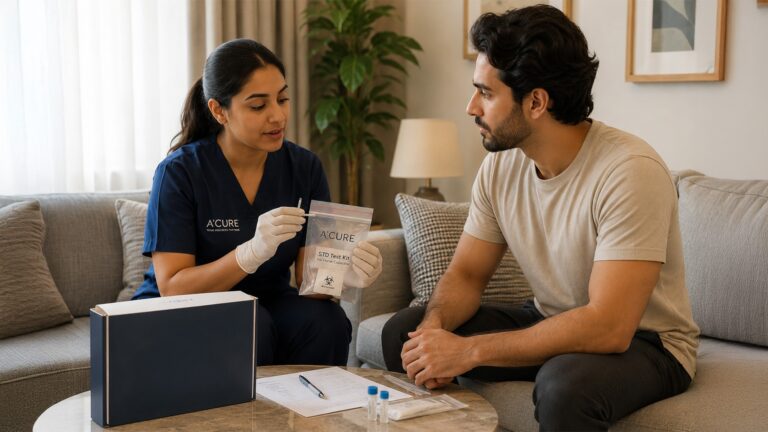
An std test at home is one of the more commonly booked services, mainly because privacy is as important as accuracy for this category. A confidential at-home STD check means no reception desk conversation and no waiting room, just a private sample collection at your convenience. HIV test at home screening works the same way, with results delivered discreetly rather than through a call from a clinic. A pcr test at home is another frequently requested service, whether for travel documentation, workplace requirements, or general precaution. A proper throat swab test collected by a trained phlebotomist tends to be more reliable than a self-administered kit, since technique affects accuracy more than people expect.
Hormonal and Fertility Testing
A hormonal test at home can cover a wide range of needs, from a full thyroid test at home panel to an estradiol e2 test for anyone monitoring reproductive hormone levels. A BHCG test is commonly used for early pregnancy confirmation, and for expecting parents, a NIPT test provides non invasive prenatal screening without an in clinic visit. A semen analysis test can also be arranged at home, though it requires careful handling and clear instructions to maintain sample quality before it reaches the lab.
Food Intolerance and Allergy Testing
People often confuse these two, so it is worth knowing the difference before booking. A food intolerance test at home looks at delayed reactions tied to digestive issues, fatigue, or skin problems, while an allergy test at home checks for classic immune responses to specific triggers. They use different testing methods entirely, so booking the wrong one wastes both time and money.
What to Check Before You Book
Not every home testing provider operates to the same standard. Confirm that the company is licensed by your local health authority, that samples are processed in an accredited lab rather than an unregulated facility, and that the phlebotomist arriving at your door is certified rather than simply a courier. Ask about turnaround times upfront, and check whether any of your chosen tests require fasting beforehand, since panels involving glucose or insulin usually do.
In the UAE, providers like Genex Lab operate under Dubai Health Authority approval and offer home collection across most of these categories, from routine blood work to STD screening and hormonal panels. Checking for that kind of licensing is a reasonable first filter no matter which company you are considering.
Final Thoughts
At-home lab testing has moved well past being a convenience trend. When handled by a properly licensed provider, it offers the same accuracy as an in-clinic visit while removing most of the friction that keeps people from testing as often as they should. Understanding what each test actually measures, from a basic MCH blood test to a full hormonal panel, makes the results far more useful once they land in your inbox, and makes it easier to know exactly what to book the next time around.